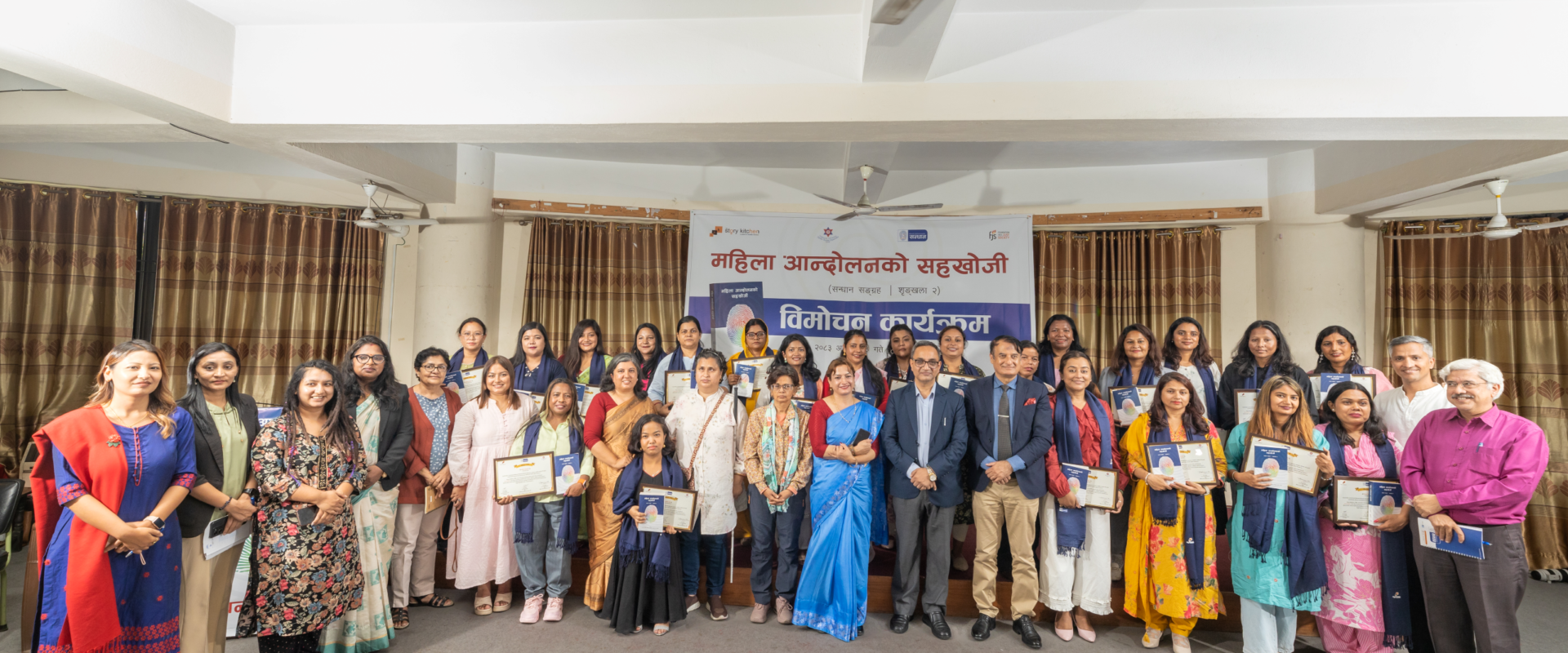
The second series of the book Co-exploration of the Women’s Movement: Sandhan Collection, a collection of research based articles grounded in feminist philosophy, was launched on Tuesday, Ashoj 13, 2083 at Siddhicharan Hall-Nepal Academy, Kamaladi, Kathmandu. The book has been published in joint collaboration between The Story Kitchen and the Central Department of Gender Studies, Tribhuvan University (TU).
The book includes the experiences and voices of women representing the diverse backgrounds of women in Nepal, as well as the struggles they have had to undertake even over fundamental aspects of life and their contributions to political and social movements. The book contains articles by 25 fellows/authors. The book approximately has 450 pages and covers topics related to diversity among women, as well as the multiple forms of discrimination experienced by women with disabilities within Dalit and Indigenous/Janajati communities, and issues concerning the gender and sexual minority communities.
Reviewing the book at the event, Prof. Dr. Kundan Aryal, Head of the Central Department of Journalism and Mass Communication at Tribhuvan University, stated that the book is significant for Nepal’s women’s movement and stated; it has identified and raised alternative issues within Nepali society. Describing some of the articles as particularly powerful, Dr. Aryal said that the book would serve as a reference material for scholars and researchers of Nepal’s women’s movement and society.
Another reviewer of the book, Sociologist Dr. Meena Paudel, expressed the view that, in a context where the same class and similar histories are repeatedly being written, this book represents an alternative journey in history writing. Stating that feminist research methodology is different from traditional research methods that counted heads and produced statistics, she said that writing on social justice has been incorporated into this book through this methodology. She also stated that although Sandhan fellows did not conduct their research with an academic purpose or as academics, the issues raised in the articles included in this book would serve as an important foundation for the construction of academic knowledge.
At the program, young Lawyer and Activist Kunjani Pariyar, Women’s Human Rights Activist Shyam Kumari Sah, and Gen-Z activist Monika Niroula expressed their views on “The Importance of the Book from the Perspective of Inter-Generational Knowledge Transfer, Diversity, and Inclusion,” stating that the book has addressed issues of diversity. They also emphasized the importance of continuing the work of collective inquiry, highlighting the need for future research of this kind to represent the aspirations and perspectives of women from the younger generation, with the understanding that doing so would help make the goal of documenting women’s history increasingly meaningful.
The Chief Guest of the program, Prof. Dr. Dubinanda Dhakal, Dean of the Faculty of Humanities and Social Sciences at Tribhuvan University, stated that the book has explored many other issues that have not yet entered intellectual discourse through the subjects discussed in it, and that the book also identifies various issues that have not been brought into public discussion in society. He further described the book as a “corpus” of articles prepared by incorporating the actual experiences and empirical facts of women, and expressed the view that, on this basis, further analysis and theorization could be carried out at the academic level.
The Guest Speaker at the program, Dr. Mrigendra Bahadur Karki, Executive Director of CNAS, stated that the use of fingerprints on the cover of Sandhan and the book carries significant meaning, as it conveys the message to everyone that every individual has their own identity. He said that since fingerprints can’t be identical and each fingerprint represents an individual’s unique identity, the book also conveys the idea that every woman should have her own identity and that this should be understood and treated accordingly, with equal recognition and respect for each individual’s experience.
Dr. Jaya Luintel, Co-Founder and Chairperson of The Story Kitchen, stated that Sandhan has started the work of writing histo-journalism and that it has now begun the work of opening a window through which history can be explored. She said that The Story Kitchen has been collaborating with universities with the understanding that the knowledge emerging from the discriminatory lived experiences, struggles, and specific contexts and circumstances of Nepali women, or our mothers and grandmothers, should also be transformed into academic knowledge. Stating that The Story Kitchen is engaged in searching for “Her-Story” in a society where only “His-Story” has been regarded as history, she explained that this work is not about removing men from history, but rather about placing women’s contributions, struggles, and lived experiences at the center of historical documentation and producing, publishing, and disseminating knowledge-based materials.
Nirmala Gyawali, an Executive Member of The Story Kitchen, thanked everyone who supported the initiative from the beginning of the fellowship through the publication of the book. Expressing confidence that everyone’s support and cooperation would continue in the coming days for “Her-Story” writing, she also stated that The Story Kitchen would continue collaborating with various departments of universities and other organizations in this kind of work.
Likewise, Jamuna Siwakoti, Head of the Central Department of Gender Studies at Tribhuvan University, which has been collaborating on the Sandhan Fellowship and book publication, stated that the department has been collaborating on this kind of work for the past eight years and that such collaboration would continue in the coming days as well.
Gardika Bajracharya, Program Lead and Office Head of The Story Kitchen, stated that although the real lived experiences of Nepali women and their contributions and roles in social and political change have been highly significant, they have only occasionally been found to be assessed as supplementary elements in formal historical documentation. She said that the book was published by documenting those overlooked experiences, struggles, and knowledge. She stated, “This was not merely a book-launching program; it was a celebration of a collective effort that has succeeded in documenting, through collaborative research and co-writing, the diverse women’s movements of Nepal, their struggles, leadership, contributions, experiences, and knowledge.”
“Sandhan” is an online portal initiated by The Story Kitchen that publishes and disseminates materials prepared through collaborative research from a feminist perspective. Since 2022, The Story Kitchen has been providing the “Sandhan Fellowship” every year to journalists, writers, and students engaged in study and research at universities. Under the fellowship, the collection of articles by 21 fellow authors from the first and second cohorts, Co-Exploration of the Women’s Movement, Sandhan Collection Series-1, was published in 2024. The first collection is also approximately 450 pages long. The first series, initially published in Ashadh 2081, has also had its second edition published in Asoj 2083.